
Watch in action:
Watch in action:
Watch in action:
Watch in action:
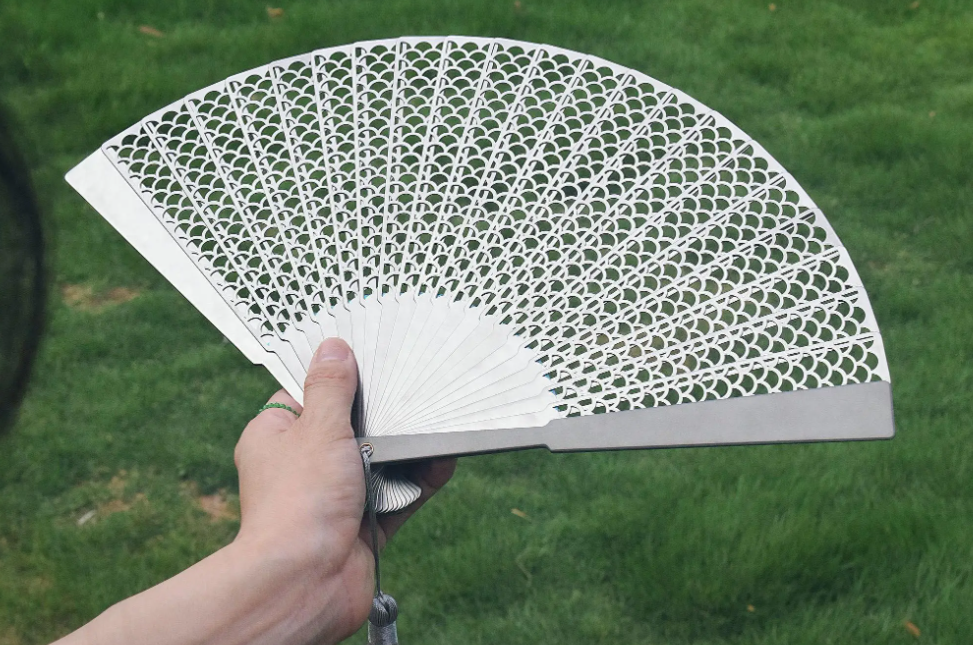
问道 (Wendao) — literally “Ask the Way” — is FEGVE’s top-tier titanium fan series. The name comes from the ancient Chinese philosophical concept of seeking one’s path, and it’s an apt descriptor: the Wendao series represents FEGVE’s answer to the question of what happens when traditional Chinese fan-making craft meets precision CNC titanium manufacturing. This isn’t just a premium product tier — it’s a philosophical statement about the relationship between heritage and modernity.
The Meaning Behind “问道”
The phrase “问道” appears throughout Chinese classical literature, most notably in the Dao De Jing and the Zhuangzi. In the context of a fan, it implies a dialogue between the maker and the tradition, between the material (TC4 titanium) and the form (the 3,000-year-old folding fan shape), between function and art.
FEGVE’s founder has described the Wendao series as “asking the way of the fan” — taking the question of “what should a premium titanium fan look and feel like” and pursuing the answer with obsessive craft detail. The result is a fan series that commands a significant price premium over the Breeze (轻风) and even the Qilin (麒麟) series, justified by hand-finishing details that CNC alone cannot replicate.
Three Head Styles: He Shang Tou vs Qinfang vs Ma Ya
The Wendao series is available in three distinct head configurations, each with different tactile characteristics:
和尚头 (He Shang Tou — Monk’s Head)
The monk’s head style features a rounded, polished terminal at the top of each fan rib — resembling the tonsured head of a Buddhist monk. The rounded terminus adds a small amount of mechanical complexity to the pivot system and requires more precise CNC work to achieve consistent spacing between ribs.
In hand: The rounded heads feel softer and more organic. When you hold the fan, the tips don’t have sharp edges. This is the most comfortable grip of the three styles, and the one I’d recommend if you’re using the fan primarily for cooling (i.e., actually waving it).
Opening feel: Slightly stiffer on new units due to the rounded geometry adding friction at the pivot. Breaks in over 20-30 cycles to a smooth, controlled action.
琴方 (Qinfang — Ancient Guqin)
The琴方 style takes its name from the ancient Chinese guqin zither — the head of each rib has a flat, slightly angled surface reminiscent of the guqin’s string anchors. The angles catch light beautifully, creating subtle geometric reflections when the fan is open.
In hand: The angular geometry feels more precise and intentional than the monk’s head. The flat surfaces provide more grip when holding the fan, which matters if your hands tend to sweat or if you’re using the fan for martial arts practice where grip matters.
Opening feel: The cleanest mechanical action of the three. The 琴方翻轮 (qinfang with flip wheel) variant adds a small roller at the pivot that further smooths the open-close cycle and reduces wear on the rivet system. If you’re buying the Wendao primarily as a fidget object, this is the head to get.
马牙 (Ma Ya — Horse Tooth)
The horse tooth style has a serrated or notched profile at the rib terminus, resembling the traditional martial arts “horse tooth” fan style used in northern Chinese martial arts (specifically Bagua and Xingyi associated fan forms).
In hand: The serrated profile provides the most grip of the three — these fans are clearly designed with martial arts practitioners in mind. The notches aren’t sharp enough to cut, but they do catch fabric and provide a distinctly non-slip grip surface.
Opening feel: Tightest action of the three. The notched geometry creates slightly more stiction at the pivot on new units. Worth breaking in deliberately if you buy this version.
Lin Sai Engraving: The Handcraft Dimension
The Wendao series features 林赛雕金 (Lin Sai engraving) — hand-engraved metalwork applied to the fan ribs after CNC machining. This is where the artisan dimension becomes real: CNC can produce consistent geometry, but only human hands can create the variable line quality, the slight imperfections, and the organic flow that makes engraved metal look alive rather than printed.
The engraving is typically a traditional motif — cloud patterns, wave patterns, or abstract geometric designs inspired by traditional Chinese ornamental art. FEGVE’s engravers work from reference drawings but interpret them with slight variations, so no two Wendao fans have identical engraving patterns. This is the key differentiator between Wendao and the Qilin series: both have engraved motifs, but Qilin uses CNC-engraved patterns that are identical across units.
Meteorite Crater Texture: FEGVE’s Signature Surface
Several Wendao variants feature the 陨石坑纹理 (meteorite crater) texture — FEGVE’s signature surface treatment where the titanium ribs have a CNC-engraved pattern of overlapping circular depressions, then hand-finished to soften the sharpest edges while preserving the three-dimensional quality of each crater.
The meteorite crater texture serves both aesthetic and functional purposes:
- Aesthetic: The crater pattern is immediately recognizable as FEGVE. It creates visual interest and a sense of depth that flat titanium or mirror-polished surfaces lack.
- Grip: The textured surface provides significantly more grip than smooth titanium, which matters when you’re opening or closing the fan with sweaty hands or in humid conditions.
- Wear hiding: The textured surface is remarkably good at hiding minor scratches and wear marks. After a month of pocket carry, my meteorite crater Wendao looks almost identical to day one.
Carbon Fiber Fan Surface: Traditional Form, Modern Material
The carbon fiber fan surface option on Wendao represents the most dramatic contrast between traditional form and modern material. The fan shape follows traditional patterns, but the panels are ultra-light carbon fiber weave rather than silk or cotton.
This combination is compelling: you get the traditional folding fan form factor, the cultural significance, and the satisfying acoustic snap when you close the fan — but at 8-12g per panel versus 15-20g for silk. The carbon fiber also won’t absorb moisture, won’t tear if folded slightly wrong, and won’t delaminate in humidity. It’s the material that makes sense if you want the Wendao as a daily carry piece rather than a display object.
Why Does Wendao Cost More? The Craft vs CNC Equation
The Wendao series costs roughly 2-3x the Breeze series, which raises a fair question: what are you actually paying for?
- Hand engraving (Lin Sai): CNC engraving on the Qilin series costs roughly the same per unit regardless of complexity. Hand engraving is labor-intensive and the rate depends on design complexity and engraver skill. This alone accounts for 30-40% of the Wendao price premium.
- Premium head machining: The he shang tou, qinfang, and ma ya head styles require additional CNC operations beyond standard fan ribs. Each head is machined as a separate piece and fitted to the rib, then hand-finished for alignment.
- Material selection: Wendao fans use TC4 titanium stock with tighter dimensional tolerances than the Breeze series. Rejected ribs are scrapped rather than sold as Breeze-series fans, effectively raising the per-unit cost of acceptable Wendao ribs.
- Hand finishing and inspection: Each Wendao fan is individually inspected, hand-adjusted for pivot tension, and packaged with more care than standard series.
Is it worth it? If you appreciate handcraft and intend to carry the fan daily as a statement piece, yes — the Wendao is the best titanium folding fan FEGVE makes. If you’re buying primarily as a fidget object or a functional cooling tool, the Breeze series delivers 80% of the experience at 40% of the price.
Two Generations of Craft: The Story Behind the Product
The Wendao series was developed over several years through collaboration between FEGVE’s founder (who brought 30 years of precision machining experience) and traditional fan-making artisans from Zhejiang province who contributed knowledge of traditional rib geometry, folding mechanics, and the cultural significance of different fan styles.
The founder has described the development process as humbling — learning from craftspeople who had spent their lives working with bamboo fans, and finding ways to translate that knowledge into titanium while preserving what made the traditional forms work in the first place.
Final Assessment
The Wendao titanium fan series is not for everyone — and that’s precisely the point. It’s a premium product for buyers who understand what they’re paying for: hand engraving that can’t be replicated by machine, head styles that require artisan-level fitting and finishing, and a surface texture that’s become FEGVE’s visual signature.
If you want the best titanium fan FEGVE makes, with the full weight of traditional Chinese craft behind it, the Wendao series delivers. If you want the titanium fan experience at a reasonable price, look at the Breeze series. Both are excellent. The Wendao is simply more excellent — in the way that matters to people who care about these things.
See also: The Modern Titanium Fan — complete breakdown of all FEGVE fan series. And The FEGVE Brand Story — the full story behind these products.