
Watch in action:
Watch in action:
Watch in action:
Watch in action:
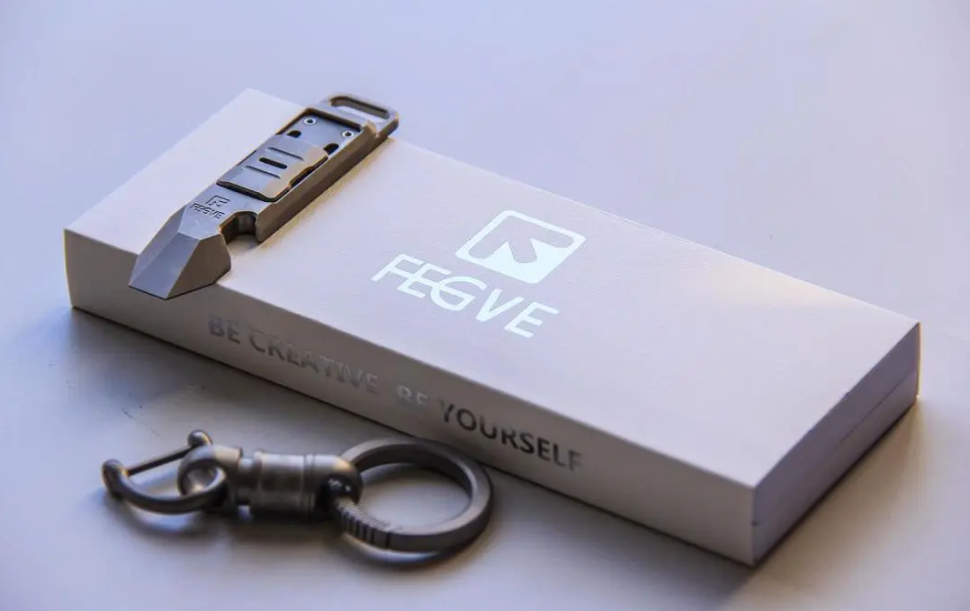
The fidget tool category has evolved from the 2017 spinner craze into something more nuanced. Spinners still exist, but the current wave of EDC fidget objects — push cards, haptic coins, magnetic tensors — serve the same function without the “toys” connotation. FEGVE’s titanium push card and lighter lineup sits at this intersection: functional objects with genuinely satisfying fidget mechanics. Let me break down what they got right and where the compromises are.
The Evolution of Push Cards: From Novelty to EDC Standard
The push card (推牌/推推牌) is essentially a flat, coin-shaped titanium object with a sliding or rocking mechanism that creates resistance, sound, and tactile feedback. Think of it as a two-dimensional fidget spinner — no spinning, but the sliding action provides a similar kinesthetic satisfaction.
What made the push card category take off is that it’s socially acceptable in situations where spinning a fidget spinner would be distracting. Conference calls, meetings, waiting rooms — a push card can be operated subtly in your palm without drawing attention. This is a significant advantage over spinners for office EDC.
FEGVE Matchbox Push Card: Dual-Function Design
The FEGVE 火柴盒 (matchbox) push card is a particularly clever concept: a titanium housing shaped like a matchbox that contains both the push card mechanism and actual matches or a striker. In practice, the matchbox functionality is real — you can light a match with the built-in striker strip — but the primary appeal is the push card itself.
The push mechanism uses a central slider that rocks back and forth across two bearing-supported posts. The fidget feel is determined by the spring tension, the bearing smoothness, and the acoustic properties of the titanium body. FEGVE’s implementation is tuned for a slightly dampened feel — not completely silent, but not clacky either. There’s a satisfying metallic “tok-tok” that varies slightly depending on how hard you push.
The resistance curve is well-balanced. It takes enough force to feel substantial, but not so much that one-handed operation becomes awkward. After breaking in, the mechanism smooths out considerably — the initial stiction disappears and the action becomes fluid.
Push Card Feel Analysis: Damping, Sound, and Haptic Feedback
I’ve compared the FEGVE push card against three other titanium push card designs on the market, and the key differentiator is the damping profile. Some push cards are too bouncy — the slider rockets back and the impact at the end of travel feels harsh. Others are too damped — the action feels sluggish and dead.
FEGVE’s balance sits at the “controlled rebound” point. The slider moves through its arc with a clean resistance curve, hits the end stop with a subtle but present impact, and returns with a spring-assisted motion that’s fast but not jarring. The titanium body resonates slightly on impact, adding a subtle acoustic quality that you can feel through your fingertips.
The haptic coin variants (solid flat discs with no moving parts, relying on thumb friction) are different animals entirely. They’re quieter, subtler, and better suited for truly discreet fidgeting. The push card has more “presence” — both in hand and in sound.
FEGVE Titanium Lighter: What the Titanium Shell Actually Means
FEGVE makes a ZIPPO-style oil lighter with a titanium shell. Let me address the elephant in the room: a lighter’s functionality depends entirely on the internal mechanism (the zipper/valve/cotton/wick assembly), not the outer shell. A titanium shell lighter performs identically to a brass or steel one in terms of flame. So what does titanium add?
Three things, genuinely:
- Weight and presence: A titanium lighter has a satisfying heft without being heavy. It feels more “premium” in hand than the standard brass ZIPPO, which can feel cheap despite its functionality.
- Corrosion resistance: Standard brass ZIPPO shells corrode with pocket carry — especially if you get them wet or if your hand sweat is acidic. Titanium doesn’t care. It’ll look the same in 10 years as it does today.
- Temperature resistance: Titanium handles temperature extremes better than brass. No warping, no dezincification, no issues in a hot car.
The titanium shell lighter is a quality-of-life upgrade for an existing user base, not a functional revolution. If you’re already a ZIPPO/butane lighter user, the titanium shell is worth it for durability alone.
Titanium Copper Inlay and Zirconium Damascus: Collector-Grade Versions
FEGVE offers premium versions with copper inlay (钛镶铜) and zirconium Damascus (锆马士革). These are clearly aimed at the collector/display market rather than pure utility users.
The titanium copper inlay version adds copper strips or geometric patterns that are either etched or embedded into the titanium body. Copper is softer than titanium, so the inlay areas develop a patina faster than the surrounding titanium — creating a natural, evolving aesthetic over time. This is a feature, not a bug, for users who appreciate patina development.
The zirconium Damascus lighter is a different beast entirely. Zirconium is a reactive metal that forms a colored oxide layer during the Damascus forging process, creating natural gold, blue, and purple colorations in the pattern — without any dye or coating. These are genuinely rare objects. If you’re a collector, these are worth the premium. If you want a daily-use lighter, the standard titanium shell is the better choice.
Push Card vs Spinner vs Haptic Coin: Which Fidget Object Fits You?
The fidget tool category serves two distinct needs: active fidgeting (needs motion, sound, engagement) and passive fidgeting (needs subtle, covert engagement). Here’s how to choose:
- Push card: Best for active fidgeting in semi-public settings (office, waiting room). Medium noise level, discrete palm operation, satisfying tactile feedback.
- Spinner: Best for active fidgeting in private or open settings. Higher engagement level, more variety, but socially noticeable.
- Haptic coin: Best for passive/covert fidgeting. Near-silent, pocket-operable, excellent for meetings and calls. Lower engagement but higher discretion.
If you’re buying your first EDC fidget object, start with a push card. If you want the maximum engagement per dollar, a quality spinner is the classic choice. If you need something truly covert, a haptic coin is the answer.
Final Verdict
The FEGVE push card and lighter products occupy a sweet spot in the EDC fidget market: they’re built from quality materials (TC4 titanium, genuine bearing mechanisms, proper internal lighter assemblies), they’re priced fairly relative to the competition, and the fidget mechanics are genuinely well-tuned. The dual-function matchbox design is clever, the collector-grade versions are legitimately beautiful, and the standard titanium shell lighter is a practical upgrade.
If you’re looking for a fidget tool that won’t embarrass you in a business meeting, the push card is the answer. If you’re a lighter enthusiast who wants a case worth carrying, the titanium shell ZIPPO is the way to go.
See also: Precision Fidget Spinners for Adults — FEGVE’s spinner lineup explained. And Understanding FEGVE Surface Finishes for details on blued, PVD, and Damascus treatments.