
Watch in action:
Watch in action:
Watch in action:
Watch in action:
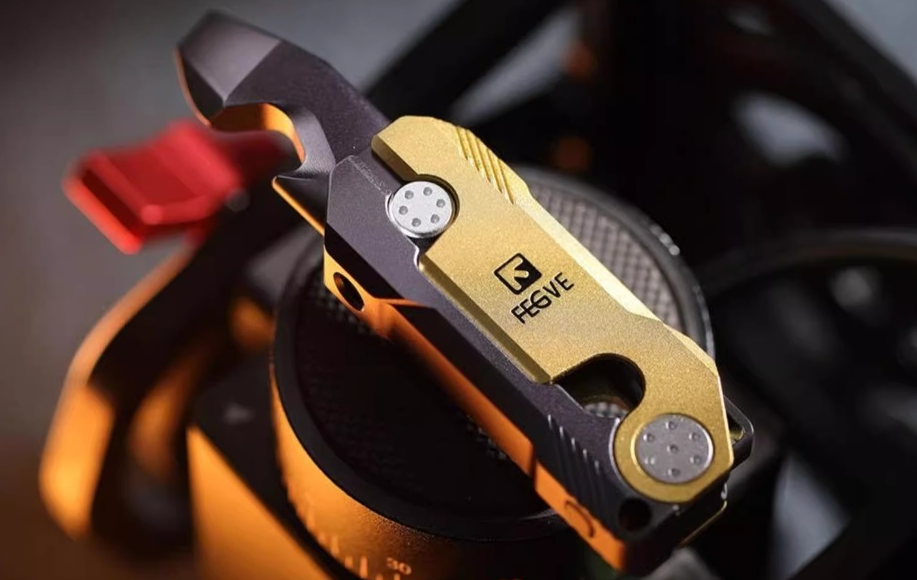
The EDC “pry bar” category is one of those things that sounds unnecessary until you actually start using one. Then you wonder how you ever opened cardboard boxes with a folding knife, or leveraged open a stuck lid without scratching it. FEGVE makes two distinct products in this space: the gravity pry bar (枪推萝卜撬棍) and the radish knife (萝卜小刀), both in titanium. Let me break them down separately and tell you where each actually fits.
What Does an EDC Pry Bar Actually Pry?
Let me be specific, because “pry bar” covers a lot of ground:
- Cardboard boxes: The most common use. Sliding the flat tip under tape and flap seals without destroying the blade or your fingernail.
- Stuck lids and caps: Paint cans, pickle jars, the annoying shrink wrap on electronics. The leverage multiplication is real.
- Quick adjustments: Some variants include a flathead or Phillips screwdriver tip, useful for eye glasses screws, watch batteries, and the random Phillips head you encounter.
- Bottle opener: Built-in bottle openers on pry bars are one of the most genuinely useful integrations I’ve encountered in EDC tools.
The radish knife (萝卜刀, named for its carrot-like profile) is a sliding pocket tool that uses a spring-loaded gravity mechanism. When you shake it, the blade extends and locks — hence the “radish” handle shape that makes it easy to grip. It’s less a pry bar and more a multi-function pocket fidget tool with a functional blade tip.
FEGVE Gravity Pry Bar: Design and Feel
The FEGVE gravity pry bar uses a sliding tube mechanism — shake the body and the inner shaft extends, locking at full extension with a positive click. The resistance tuning is important: too loose and it rattles in your pocket. Too tight and the gravity mechanism doesn’t engage reliably. FEGVE’s implementation sits in a good middle ground, with enough damping that the extended shaft doesn’t feel fragile.
The lockup at full extension is solid — a distinct mechanical stop that you can feel and hear. I’ve had no instances of the shaft collapsing under normal use. Under significant lateral pressure (prying), the shaft does flex slightly — this is expected from titanium, which has good strength-to-weight but isn’t as rigid as steel. Don’t expect this to replace a real steel pry bar on a construction site.
The integrated bottle opener and screwdriver tip (Phillips + flathead) are genuinely useful. The flathead doubles as a small flathead screw driver and a pry tip for tape and packaging. The Phillips tip is shallow — fine for eyeglass screws, not deep enough for electrical outlet covers or structural fasteners.
M390 Steel Radish Knife: Powder Steel Performance
The M390 radish knife variant uses Bohler-Uddeholm M390 “Super Steel” — a PM (powder metallurgy) tool steel with excellent edge retention and corrosion resistance. M390 runs about HRC 60-62 in typical EDC configurations, which is very good but not quite at the extreme end of the spectrum (M4 or S90V run harder, but with significant tradeoff in corrosion resistance).
In practice, the M390 radish knife blade is genuinely sharp out of the box — FEGVE’s CNC grinding and hand honing produces a clean, consistent edge. The blade is short (around 35-40mm) and straight-pointed, suitable for cutting tape and packaging, opening letters and thin cardboard, food prep in a pinch (the M390 stainless steel won’t rust if you cut an apple), and light outdoor tasks.
What it’s not: a folding knife replacement. The short blade and sliding mechanism mean this is a light-duty cutter, not an all-purpose blade.
Damascus Pattern Variant: Aesthetic vs Performance
FEGVE also offers a Damascus steel version of the radish knife. Let me be direct: Damascus in this context is primarily a visual statement. The pattern is acid-etched into the steel and is decorative rather than functional. Modern Damascus can achieve good performance, but the pattern itself doesn’t add cutting performance.
That said — the Damascus variants look spectacular. The etched pattern catches light differently, and the contrast between the dark etching lines and the polished bevel is genuinely beautiful. If you’re buying a radish knife as a fidget/show piece first and a tool second, the Damascus version is worth considering.
Aluminum Gravity Pry Bar vs Titanium: The Tradeoff
FEGVE offers the gravity pry bar in both aluminum and titanium. The aluminum version is significantly lighter (about 40% lighter by volume) and cheaper. The titanium version is stronger, more corrosion-resistant, and develops a patina over time that many EDC enthusiasts appreciate.
For pure utility: aluminum is fine. It won’t corrode, it’s strong enough for normal cardboard and packaging prying, and the weight savings are noticeable if you’re already carrying a heavy key ring.
For EDC enthusiasts who want the “pocket presence” of a substantial tool: titanium. The slightly higher weight gives it a satisfying heft, and the TC4 body can take more abuse without deforming.
Daily Scenarios: What I Actually Use These For
In a typical week, my FEGVE radish knife sees the following use:
- Opening 3-5 Amazon packages (the main use case)
- Opening 1-2 letters/mail envelopes
- Occasional bottle opening (integrated bottle opener on the pry bar)
- Quick screwdriver adjustments (glasses, battery covers)
- Fidget action during calls (the gravity slide mechanism is oddly satisfying)
The pry bar has essentially replaced my folding knife for packaging tasks. A folding knife works, but it’s overkill for tape and cardboard, and you’re dealing with the open blade in your pocket.
Final Assessment
The FEGVE gravity pry bar and radish knife are both genuinely useful pocket tools — not just fidget novelties. The titanium construction is the key differentiator: these aren’t stamped zinc alloy pieces that’ll crack or rust. They’re machined from solid stock and built to last years, not months.
My recommendation: if you do a lot of package deliveries, get the gravity pry bar with integrated tools. If you’re more drawn to the fidget/display angle, the M390 radish knife in Damascus or titanium is a conversation piece that actually works.
Related: Titanium Keychains That Actually Last — including pry bar keychain combos. Also see Inside FEGVE’s Manufacturing Process for how these tools are made.