
TC4, Grade 5, Ti-6Al-4V — Same Metal, Different Names
Let’s start with the basics. When EDC brands say “titanium,” they almost always mean Grade 5 titanium — also known as TC4 (Chinese standard) or Ti-6Al-4V (the alloy composition: 6% aluminum, 4% vanadium, balance titanium). This isn’t pure titanium. It’s an alloy specifically engineered for strength, and it accounts for about 50% of all titanium usage worldwide.Here are the numbers that matter:
| Property | TC4 / Grade 5 Ti | 304 Stainless Steel | 6061 Aluminum |
|---|---|---|---|
| Density | 4.51 g/cm³ | 7.93 g/cm³ | 2.70 g/cm³ |
| Tensile Strength | ≥895 MPa | ≥515 MPa | ≥310 MPa |
| Yield Strength | ≥828 MPa | ≥205 MPa | ≥276 MPa |
| Hardness (HRC) | 36-39 | ~20 | ~15 |
| Corrosion Resistance | Excellent (passive TiO₂ layer) | Good (can rust) | Poor (pits in salt) |
The takeaway: titanium is 45% lighter than steel but significantly stronger. It’s not as light as aluminum, but aluminum can’t touch it on strength or durability. For something you carry every day, that strength-to-weight ratio is the entire point.
The Invisible Shield: Why Titanium Doesn’t Rust
Titanium doesn’t rust — not because it’s somehow immune to oxidation, but because of what happens when it does oxidize. When exposed to oxygen, titanium forms a thin, dense layer of titanium dioxide (TiO₂) on its surface. This layer is self-healing: scratch it, and it reforms instantly in the presence of oxygen.This is the same principle that makes stainless steel “stainless” (chromium oxide layer), but titanium’s passive layer is more stable and more chemically inert. It resists salt water, sweat, body oils, chlorine, and most acids. Your keychain will survive conditions that would pit and rust a steel one in weeks.For EDC gear that sits in your pocket against your skin for hours every day, this isn’t a minor detail. It’s the difference between something that degrades and something that doesn’t.
Biocompatibility: The “Feel” Factor
There’s a reason titanium is used for surgical implants and dental posts: it’s hypoallergenic and biocompatible. Your body doesn’t reject it. More practically for EDC: it won’t cause the skin irritation that some steels (especially those containing nickel) can trigger.Titanium also has unusual thermal properties. It has low thermal conductivity compared to aluminum, meaning it doesn’t feel “cold” when you first pick it up. It warms to your hand quickly and stays there. In practice, a titanium keychain feels like a natural extension of your hand rather than a piece of hardware.This is hard to quantify in a spec sheet, but it’s one of the first things people notice when they switch from steel to titanium.
Why Titanium Costs More: The Kroll Process
If titanium is so great, why isn’t everything made from it? Two words: cost and difficulty.Titanium doesn’t exist in pure form in nature — it’s always bonded with oxygen. Extracting it requires the Kroll process, which is expensive, energy-intensive, and produces low yields:
- Titanium ore (rutile or ilmenite) is heated to 1000°C with chlorine and carbon, producing titanium tetrachloride (TiCl₄) — a volatile, dangerous liquid
- TiCl₄ is purified by fractional distillation
- The purified TiCl₄ is reacted with molten magnesium in an argon atmosphere, producing titanium “sponge” and MgCl₂
- The sponge is crushed, pressed into electrodes, and melted (at least twice) under vacuum to produce ingots
- Ingots are forged and rolled into bar stock — the form that arrives at a CNC shop like FEGVE’s
That’s why raw titanium bar stock costs 5-10x more than stainless steel per kilogram. And that’s before machining.
Machining Titanium: Why It Eats Tools for Breakfast
CNC-machining titanium is genuinely difficult, and this is where a lot of the cost comes from:Low thermal conductivity: When you cut steel, the heat generated dissipates through the workpiece and the chip. Titanium? Heat stays concentrated at the cutting edge. Temperatures at the tool tip can exceed 1000°C, which destroys carbide tools rapidly.Work hardening: Titanium work-hardens during cutting, meaning the surface gets harder as you machine it. This creates a feedback loop — the harder the surface, the more force on the tool, the more heat generated.Elastic modulus: Titanium springs back after being cut. A 0.1mm depth of cut might only remove 0.07mm of material because the titanium recovers elastically. This requires multiple finishing passes at very precise depths.In practice, this means:
- Slower spindle speeds (60-70% of steel speeds)
- More frequent tool changes (every 2-3 parts vs. 20+ for steel)
- Specialized carbide tooling with TiAlN or AlCrN coatings
- High-pressure coolant systems (70+ bar)
When you buy a titanium EDC tool, you’re paying for the metal and for the extra hours of careful machining and the specialized tooling required to produce it. There are no shortcuts.
Surface Finishes: Where Titanium Becomes Art
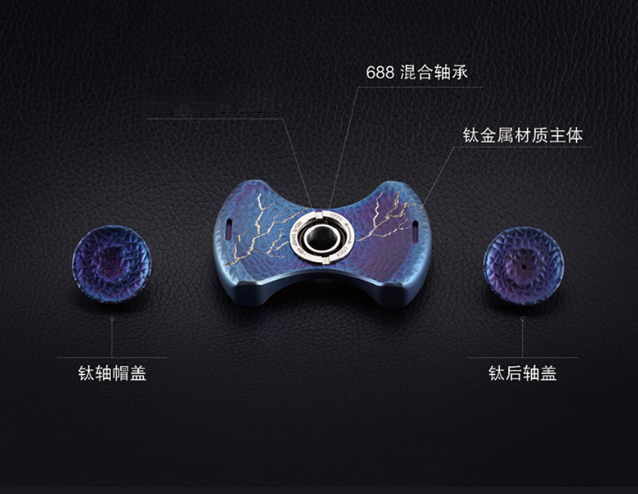
One of titanium’s most appealing properties for EDC is its versatility in surface finishing. Unlike steel (which mostly gets bead-blasted or coated), titanium offers a rich palette of options:Stonewash: Parts are tumbled with ceramic media, creating a uniform matte texture that hides scratches beautifully. This is the most practical finish for daily carry — every scratch blends in rather than standing out.Blued (thermal oxidation): Heating titanium to 400-600°C in air causes the oxide layer to thicken, producing interference colors. The color depends on temperature: straw → gold → blue → purple. No dyes, no coatings — the color is the oxide layer, so it can’t chip or wear off.PVD/DLC: Physical Vapor Deposition deposits a thin, extremely hard coating (TiN, TiAlN, or DLC) in a vacuum chamber. DLC (Diamond-Like Carbon) produces a deep black finish with exceptional scratch resistance. Gold and rose gold PVD are also common.Anodized: An electrochemical process that thickens the oxide layer in a controlled manner. By varying the voltage, you can produce a spectrum of colors — blues, purples, greens, pinks — without any pigments. The colors are interference-based, like oil on water.Meteorite Crater: FEGVE’s signature texture — CNC-engraved pits and craters across the surface, hand-finished to remove sharp edges. Each part takes 30-45 minutes of machine time plus hand work. The result is a tactile, organic texture that no other finish replicates.
The Verdict
Titanium is not the right material for everything. If you need maximum hardness, tool steel wins. If you need minimum cost, aluminum wins. But for EDC gear — things you carry daily, that need to be light enough to forget about but strong enough to depend on, that will be exposed to sweat and weather and dropped on concrete — titanium is the best material available.It’s the intersection of aerospace engineering and pocket-sized utility. The price is real. The value is, too.
Frequently Asked Questions
Is Grade 5 titanium better than Grade 2?
For EDC, yes. Grade 5 (TC4) is significantly stronger (895 MPa vs. 345 MPa tensile strength) while being only slightly heavier. Grade 2 is used where maximum formability is needed, but Grade 5 is the standard for machined EDC parts.Will a titanium keychain scratch?
Yes — all metals scratch. But titanium’s scratches are less visible on stonewash or textured finishes, and the metal itself won’t deform or corrode. Many EDC enthusiasts consider the patina of use part of the appeal.Is titanium magnetic?
No. Titanium is paramagnetic (weakly attracted to magnets), which for practical purposes means it’s non-magnetic. This is an advantage if you work near sensitive equipment.Why doesn’t everyone use titanium?
Cost and machining difficulty. Raw titanium costs 5-10x more than steel, and machining it requires slower speeds, more tool changes, and specialized equipment. For a brand like FEGVE that controls its own manufacturing, the economics work. For brands that outsource, the margins often don’t.Can titanium anodizing wear off?
No. Anodizing thickens the natural oxide layer — it’s not a coating applied on top. The color can fade very slowly with extreme abrasion, but it won’t chip or peel like paint or plating.